Custom Majlis Design and Fit-Out in Dubai

  • Majlis Seating and Joinery Made in Our Own Al Quoz Workshop
  • DM Approved · DEWA Certified · Trading Since 1996
  • Joinery, Upholstery and Decorative Finishes In-House
  • Free Site Visit and Itemised Quotation

Majlis seating, wall panels, Arabic calligraphy, coffered ceilings and lighting built in our own Al Quoz workshop. Book a free site visit and get an itemised quotation.

Banquette Seating Built on a Hardwood Frame, Not a Catalogue Sofa BaseWall Panels Set Out to a Real Module, With a Reveal at Every JointCoffered Ceilings Coordinated With AC Diffusers and Detectors Before BoardingUpholstery Specified in Fire-Rated, Fade-Resistant Fabric for Dubai SunDM Approved · DEWA Certified · Trading in Dubai Since 1996

Majlis Interiors Built by Halo Across Dubai

We do not publish client names or addresses without written permission, and this page does not yet carry a published majlis dossier the way some of our other rooms do — so rather than pad it with a room that is not ours, here is what we actually get asked to fix or build, and how we approach each one.

01

The Seating That Looked Right and Sat Wrong

The problem: A majlis furnished from a general sofa range that photographs beautifully and becomes uncomfortable within twenty minutes of real use, because the seat depth and height were never set for cross-legged or reclining use. How we approach it: Agree the banquette depth and seat height against how the room is actually used before the frame is built, not after.


02

The Calligraphy Panel Nobody Wanted to Fix

The problem: A printed vinyl calligraphy panel installed by a previous contractor, peeling and yellowing within a year of Gulf sun through the windows. How we approach it: Replace with a CNC-routed or hand-carved panel in a genuine substrate, checked against the source text before it is cut.

03

The Ceiling Coffer That Fought the AC

The problem: A decorative coffered ceiling designed without checking diffuser and detector positions, so the finished room has visible holes cut in wherever they happened to fit. How we approach it: Mark up every service position on one reflected ceiling plan and clear it with the ceiling contractor and electrician before the gypsum work closes the ceiling.

Majlis Seating, Wall Panels and Ceiling Design

Everything below is made in our own Al Quoz workshop and installed by our own team. Take the whole room — seating, panels, ceiling, lighting and rugs — or the single piece you actually need. A wall panel and ceiling refresh in an existing majlis is a perfectly sensible project on its own, and it touches nothing else in the room.

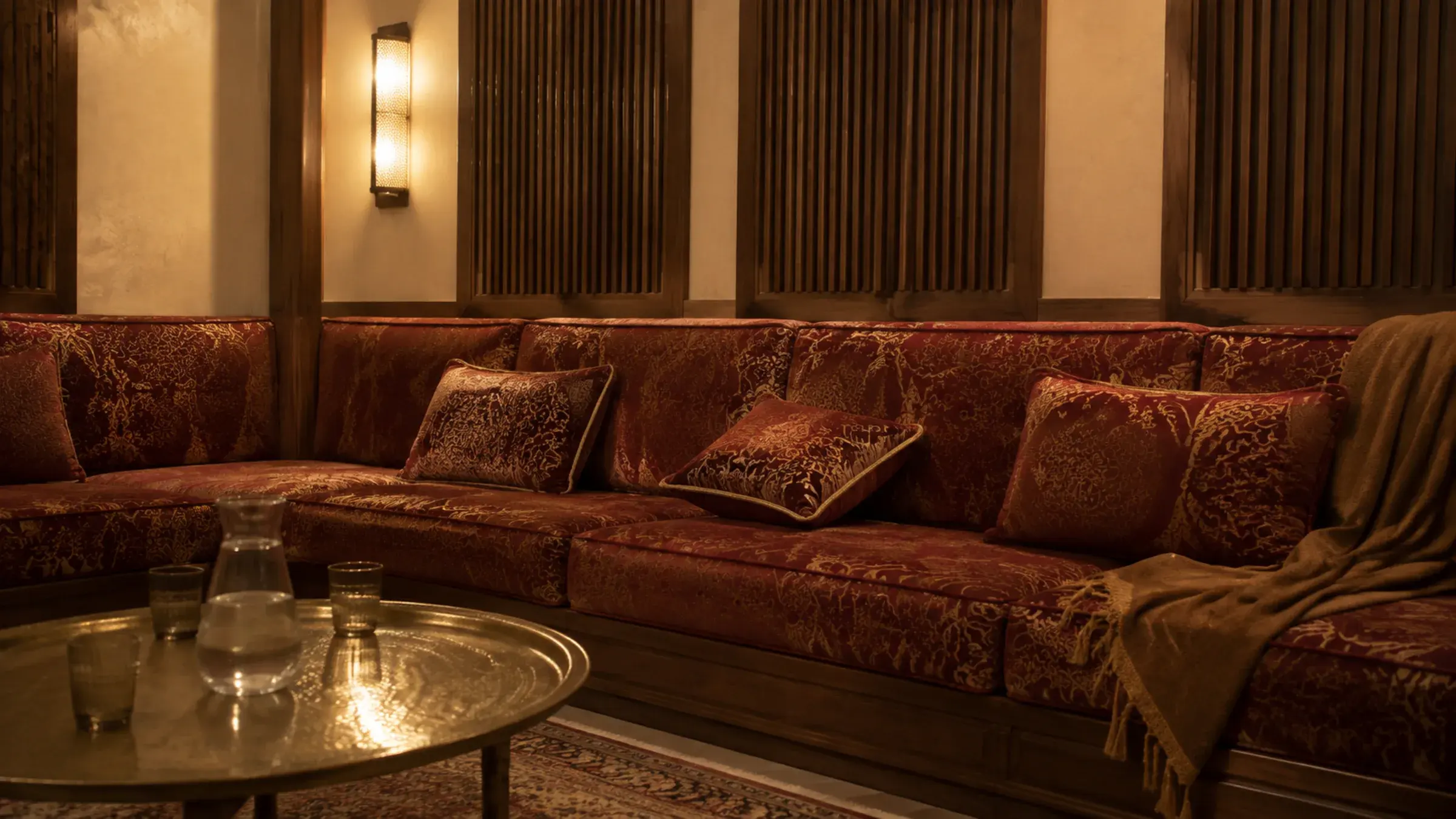
Deep burgundy and gold banquette seating along a fluted wood-panelled majlis wall with a brass wall sconce

Traditional and Arabic Seating Arrangements

Majlis seating is not a sofa pushed against a wall. It runs the full perimeter of the room on a wall-hugging banquette frame, built roughly 600–650mm deep so a guest can sit cross-legged or lean back fully, against the 550mm depth of a Western sofa. The frame is solid hardwood on webbed suspension rather than a stapled softwood box, because a majlis banquette carries continuous seated load for hours at a time and a cheap frame telegraphs through the cushion within two seasons. Foam is specified by density and ILD for how the piece is actually sat on, and corner and return modules are built to close without a visible seam.

  • Banquette depth and frame built for cross-legged and reclining use, not sofa proportions
  • High-resilience foam specified by density, not taken off a general furniture range
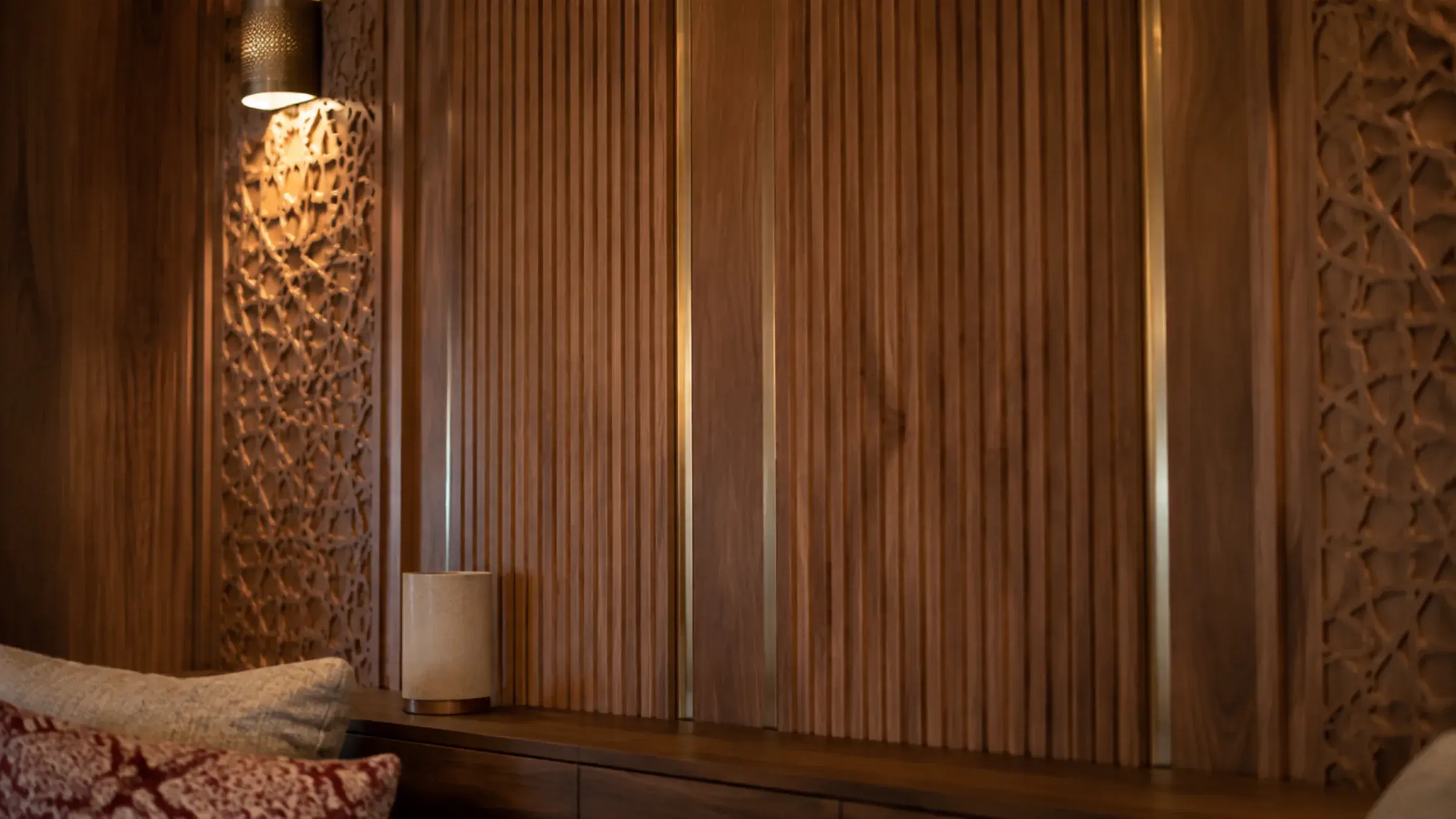
Fluted walnut wall panelling with a brass reveal and a carved geometric star panel lit by a wall sconce

Decorative Wall Panels and Arabic Calligraphy

A majlis wall is set out to a module before a single panel is cut, so a fluted or geometric run lands centred on the room rather than finishing on a half-width sliver at the corner. Calligraphy is executed one of three ways depending on scale and budget — CNC-routed into a solid or GRG (glass-reinforced gypsum) panel for a large feature, hand-carved in timber for a smaller detail, or backlit behind a pierced screen — and never as a printed vinyl decal, which peels and yellows within a year in Gulf humidity. Panels are fixed on a concealed French cleat rather than glued direct to the wall, so a damaged section can be lifted out and replaced without disturbing its neighbours.

  • Panel module set out and confirmed on site before anything is cut
  • Calligraphy CNC-routed or carved into a real substrate, never a printed decal
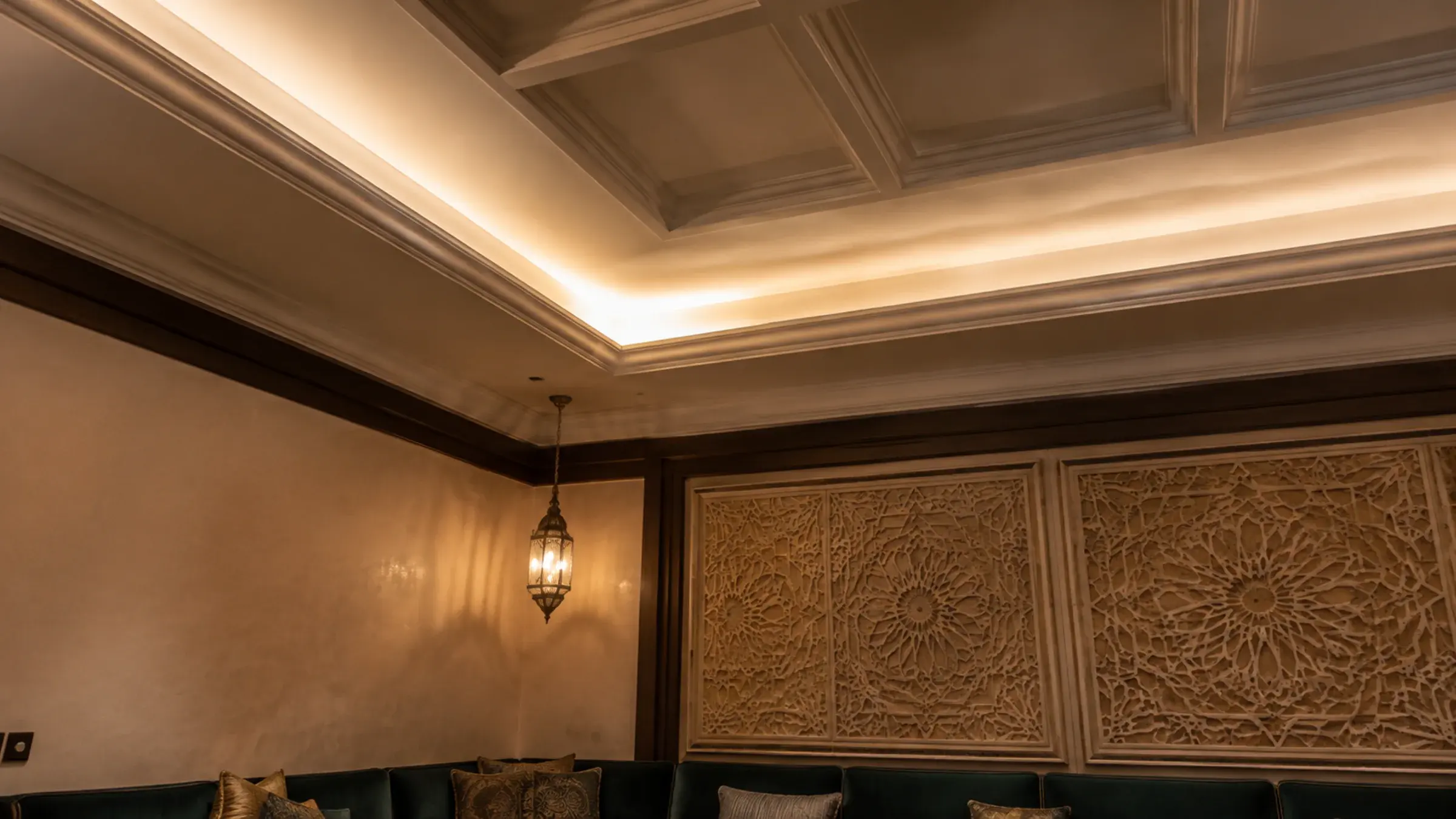
Coffered gypsum ceiling with concealed cove lighting above a carved geometric wall panel and dark green banquette seating

Ornate Ceiling Design and Coffers

A coffered majlis ceiling is a construction detail before it is a decorative one. The drop from the perimeter cove to the flat centre panel is typically 150–250mm, and that has to be agreed against the room's actual slab-to-finished-ceiling height before the gypsum contractor is booked, or the coffer eats more headroom than the room can spare. Cove lighting sits in a proper channel with a diffuser rather than a bare LED strip you can see the individual diodes of, and every AC diffuser, smoke detector and sprinkler head is marked up on the reflected ceiling plan and cleared before the ceiling is closed, not cut into it as an afterthought.

  • Coffer drop agreed against real ceiling height before gypsum work starts
  • AC diffusers and smoke detectors coordinated on the plan, not cut in after
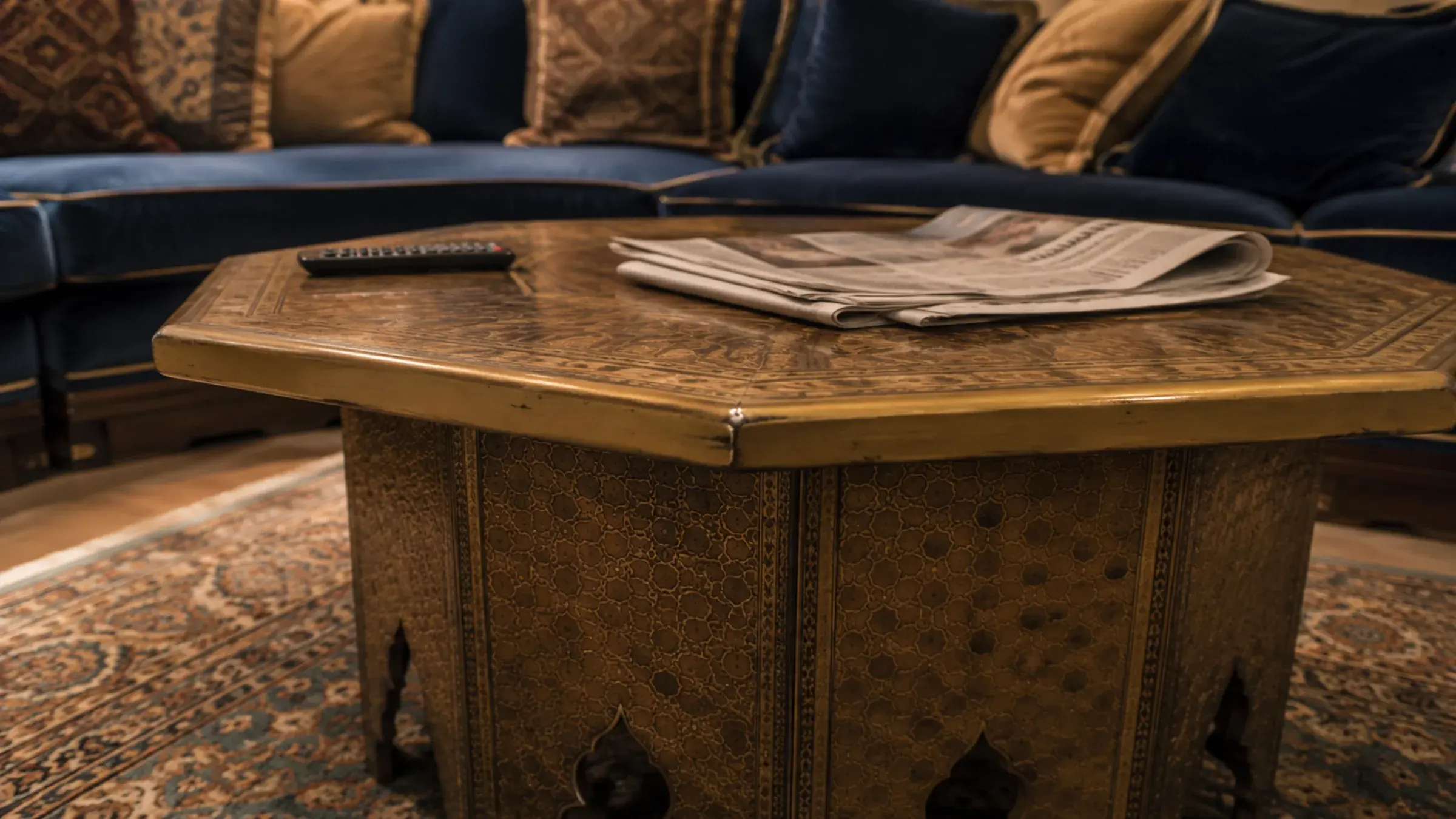
Hexagonal brass-inlaid majlis coffee table with a folded newspaper, in front of a blue velvet banquette

Custom Majlis Furniture and Low Tables

Majlis low tables sit at roughly 350–400mm rather than the 450mm of a Western coffee table, because they are reached from floor level or low banquette seating rather than an armchair. A large octagonal or hexagonal table for a full majlis needs a genuine structural frame under the veneer — a single centre leg looks right in a drawing and racks within a year under real use — and brass or mother-of-pearl inlay is set into a routed channel rather than glued flat, so the line stays crisp instead of lifting at the edge. We build to the room's actual seating layout rather than a standard table size, so the piece sits where guests can reach it without leaning.

  • Table height set for floor-level and low-seating use, not a standard coffee table
  • Inlay routed into a real channel, not glued flat to the surface
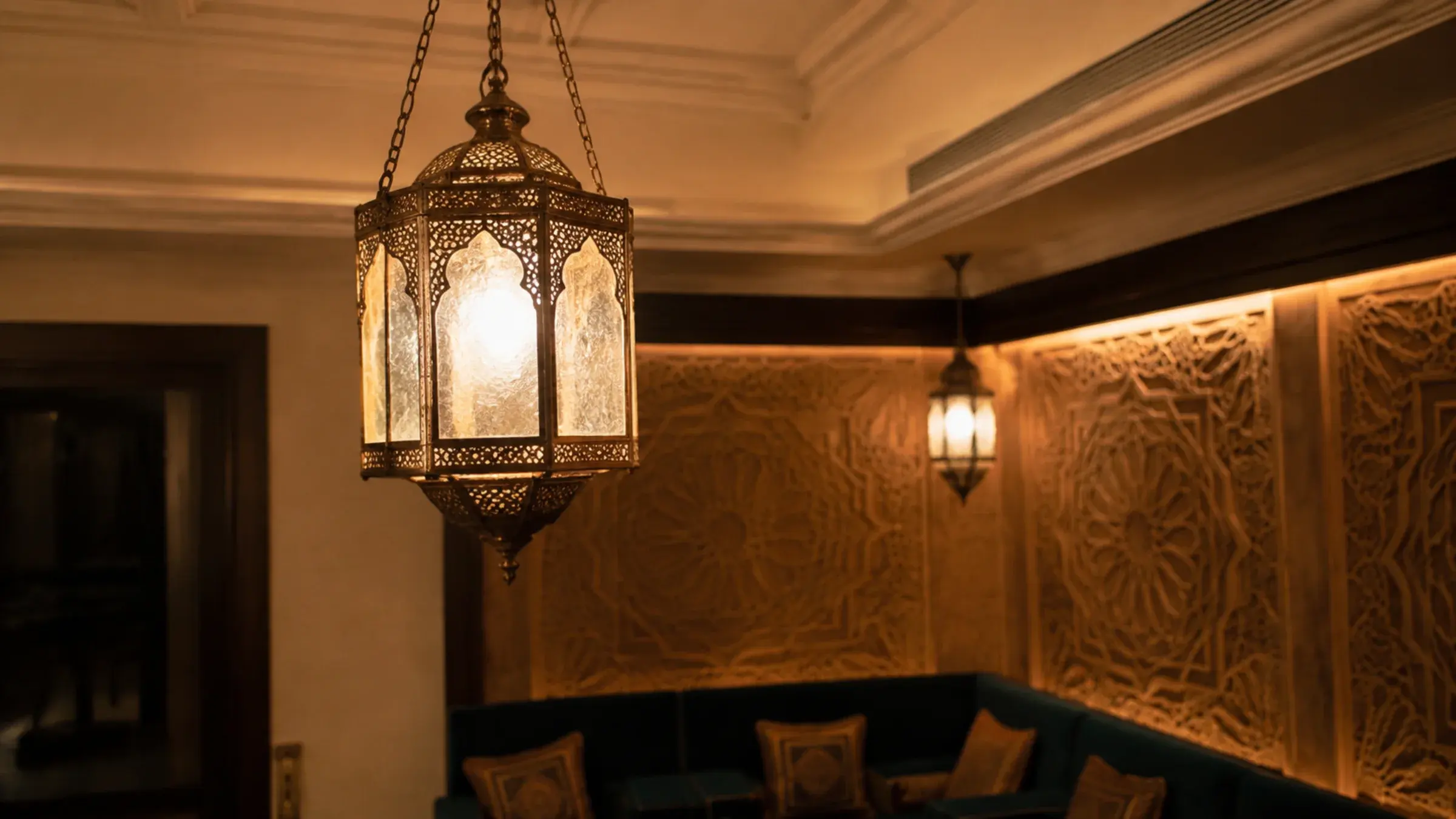
Pierced brass Moroccan-style lantern pendant lit above dark fluted wall panelling in a majlis

Ambient Lighting and Chandeliers

A majlis is lit in layers rather than from a single ceiling fixture: a central chandelier or lantern pendant for presence, wall sconces at seated eye level for warmth, and concealed cove lighting for the ceiling and wall panels behind it. Every layer sits on its own dimmable circuit, because a majlis used for a formal afternoon gathering and the same room used for an evening family sitting want completely different light levels, and a single switch cannot give you both. Fixtures are sourced as genuine pierced-metal or glass lanterns rather than a moulded plastic imitation, and every driver is placed somewhere it can be reached in five years without dismantling the ceiling around it.

  • Chandelier, wall sconces and cove lighting on separate dimmable circuits
  • Driver access planned in, so a failed driver is a short visit
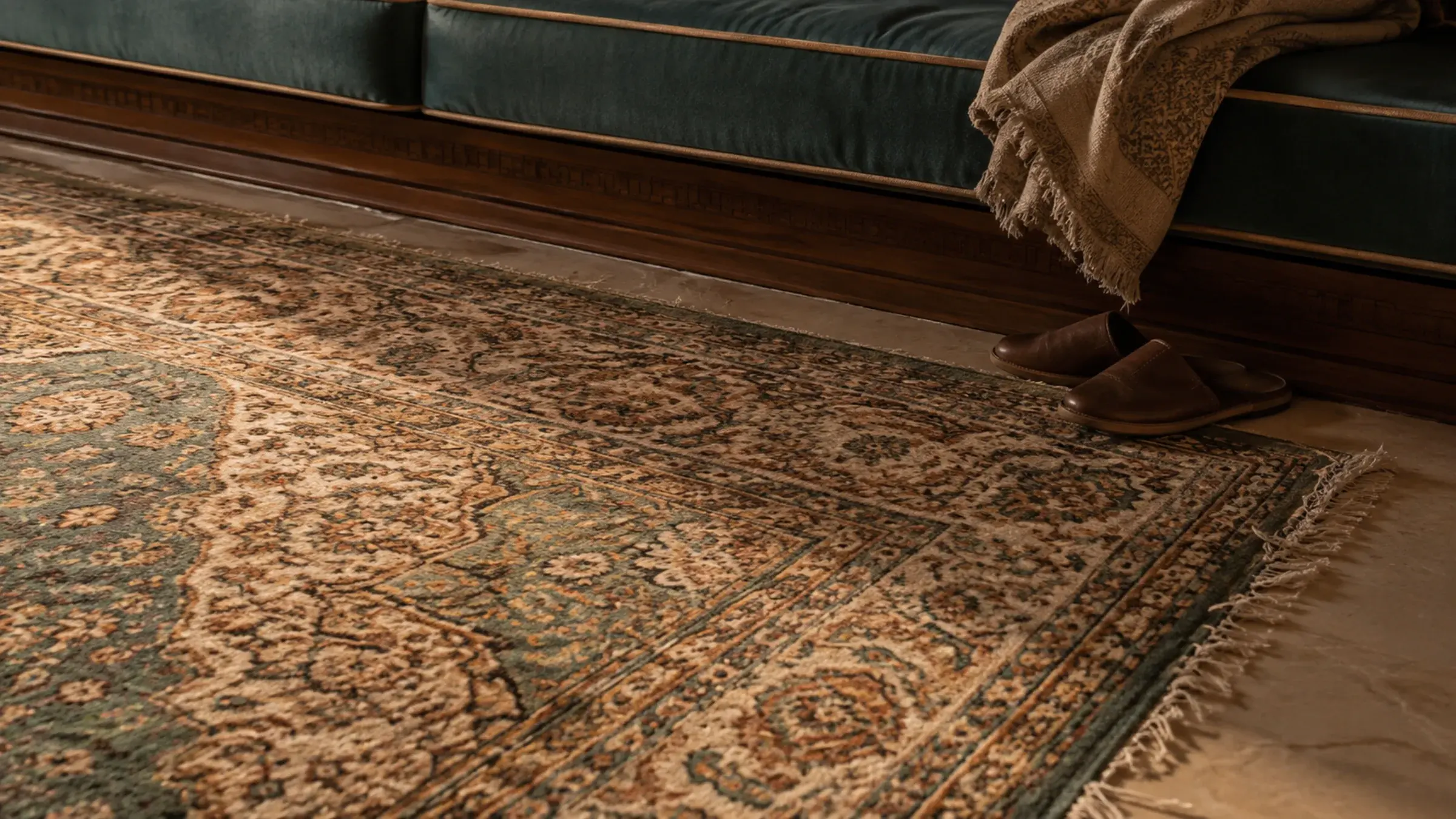
Patterned Persian-style rug beneath a majlis banquette with leather slippers resting at the edge

Carpets, Rugs and Floor Treatments

A majlis rug is sized to the room, not bought off a standard size chart — it has to reach to within a consistent margin of the banquette seating on every side, which almost never matches a stocked 200x300cm or 250x350cm rug once the room is an irregular villa shape. Hand-knotted wool or a wool-silk blend is specified for the main floor field for its wear life under a room that is walked and sat on constantly, with a proper anti-slip underlay rather than the rug simply laid on polished stone. Where budget does not stretch to a full hand-knotted piece we specify a quality machine-made rug in the same custom size rather than drop to a stock size that leaves a visible strip of bare floor.

  • Sized to the actual room, not a stocked standard rug size
  • Anti-slip underlay specified as standard on polished stone or marble floors

The Same Company Designs It, Makes It and Fits It

A majlis has more trades running through it than almost any other room in a villa. A designer draws the panels, a joinery supplier builds the seating, a gypsum contractor does the ceiling separately, and the AC diffuser lands in the middle of the calligraphy panel because nobody checked the plan against everyone else’s.

Halo surveys the room, draws the seating and panels, coordinates the ceiling and lighting, manufactures in Al Quoz and installs it — one contract, one drawing, one team to call.

Book a Free Majlis Site Visit

Survey and setting out

Measured survey of the room, wall panel module set out on the actual dimensions, seating layout agreed, and ceiling height checked against the coffer you want — confirmed on a drawing you sign before anything is cut.

Manufacture in Al Quoz

Wall panels, calligraphy pieces, furniture and any joinery elements produced in our own workshop, with fabric cut and upholstery built alongside.

Services coordination

Lighting circuits, dimmer zones, AC diffuser positions and smoke detector locations agreed with the electrician and ceiling contractor before the gypsum work closes the ceiling.

Install, style and hand over

Panels fixed, ceiling completed, seating and furniture placed, rugs laid and lighting commissioned — then the whole room adjusted and snagged before we leave.

Why Dubai Homeowners Choose Halo for Majlis Joinery

Majlis quotations are unusually hard to compare, because the visible parts are almost identical and the differences are all in the frame, the fixing and the coordination. Two rooms described as a “custom majlis with calligraphy panels and a coffered ceiling” can be entirely different things. These are the five points worth testing on anyone you shortlist — this one included.

Seating Sized for How It Is Actually Used

Banquette depth, seat height and return geometry are set for cross-legged and reclining use, not carried over from a Western sofa range. Get this wrong and the seating looks right in a photograph and is uncomfortable within twenty minutes.

Frames Built to Carry Continuous Load

A majlis banquette is sat on for hours at a stretch, often by more people than a sofa is ever asked to carry. Solid hardwood frames on webbed suspension outlast a stapled softwood box by years, not seasons.

Calligraphy Executed as Real Craft

CNC-routed or hand-carved into a genuine substrate, checked against the actual Arabic text before it is cut, never a printed decal that peels and yellows within a year of Gulf sun and humidity.

Ceiling and Services Coordinated as One Drawing

Coffer depth, cove lighting, AC diffusers and smoke detectors are agreed on a single reflected ceiling plan before the gypsum contractor starts, so nothing gets cut into a finished ceiling as an afterthought.

We Are the Manufacturer

Wall panels, furniture and upholstery made in our own Al Quoz workshop rather than ordered from a trade supplier, which is why a panel module can be adjusted on site and a table can be built to your room's actual seating line.

A Halo Majlis vs. The Typical One

Two majlis quotations can land within a few thousand dirhams of each other and describe completely different builds. Almost all of the difference is inside the frame, behind the panel and above the ceiling. Here it is, line by line.

Seating construction

The Halo Experience
  • Solid hardwood frame on webbed suspension, built for continuous load
  • Foam density and ILD specified for majlis use, not general furniture
The Typical Experience
  • A stapled softwood frame from a general sofa range
  • Standard furniture foam that flattens within a season

Wall panel setout

The Halo Experience
  • Module planned against the room before a panel is cut
  • Concealed French cleat fixing, so a panel can be replaced
The Typical Experience
  • Panels cut to fit whatever is left over at the corner
  • Panels glued flat, so damage means replacing the whole run

Calligraphy execution

The Halo Experience
  • CNC-routed or hand-carved into a real substrate
  • Text checked against the source before anything is cut
The Typical Experience
  • A printed vinyl decal applied over paint
  • Peels and yellows within a year of Gulf sun

Ceiling and services

The Halo Experience
  • Coffer, cove lighting, AC and detectors on one drawing
  • Coordinated with the ceiling contractor before boarding starts
The Typical Experience
  • A decorative coffer added after the ceiling is closed
  • AC diffusers and detectors cut in wherever they fit

Lighting

The Halo Experience
  • Chandelier, sconces and cove light on separate dimmable circuits
  • Driver access planned in from the start
The Typical Experience
  • A single ceiling fixture on one switch
  • A failed driver means opening up the ceiling

Furniture and inlay

The Halo Experience
  • Table height set for floor-level and low-seating use
  • Brass or inlay routed into a real channel
The Typical Experience
  • A standard coffee table height, borrowed from a living room range
  • Inlay glued flat, lifting within a year

Majlis Types, Panels and Finishes We Build in Dubai

Majlis conversations start with a saved photo and end with a ceiling-height question. Below is the range Halo actually builds — the majlis types, the wall and furniture materials, and the ceiling, lighting and acoustic detail that decide how the room performs when it is full of guests. What constrains your majlis is listed underneath, and it is room shape, gathering size and ceiling height rather than style.

Majlis Types We Build

Almost every enquiry starts as one of these. The style and the room decide the seating layout; the gathering size decides the scale.

  • Traditional wall-hugging Arabic majlis
  • Modern low-seating majlis lounge
  • Men's majlis and family majlis, kept separate
  • Combined majlis and dining space
  • Small apartment or single-room majlis
  • Outdoor and tented majlis for entertaining
  • Moroccan and diwan-style seating
  • Majlis integrated into a villa extension

Materials, Fabric and Finishes

The fabric and the wall finish are the two decisions that set the whole room's character, and the two most often specified from a swatch nobody has actually sat on.

  • Jacquard, velvet and fire-rated upholstery fabrics
  • Fluted, reeded and geometric timber wall panels
  • GRG (glass-reinforced gypsum) calligraphy panels
  • Backlit pierced screens and fretwork panels
  • Brass, bronze and mother-of-pearl inlay detail
  • Natural stone and large-format floor tiling
  • Hand-knotted wool and wool-silk rugs
  • Sprayed lacquer and natural veneer joinery

Lighting, Ceiling and Acoustics

What goes into the ceiling decides how the room actually performs when it is full of guests, and each of these carries a coordination requirement worth naming early.

  • Coffered and stepped gypsum ceilings
  • Concealed cove lighting on a dimmable circuit
  • Lantern-style chandeliers and pendant fixtures
  • Wall sconces at seated eye level
  • Acoustic treatment for large seated gatherings
  • AC diffuser and smoke detector coordination
  • Layered dimming zones for day and evening use
  • Feature lighting for calligraphy and wall panels

What decides your majlis before style does

Two rooms of identical size can take completely different majlis fit-outs. These are the five constraints we check at the site visit, and any one of them can rule out a design on its own.

Room shape and available wall length

An L-shaped or irregular villa room changes where the banquette can run continuously and where it has to break into a separate module — decided at survey, not guessed at from a floor plan.

How many people it actually seats

A majlis built for twelve looks sparse for thirty and a majlis built for thirty crowds a family of six. Real gathering size and frequency decide the seating run before style does.

Ceiling height and structural capacity

A coffered ceiling with cove lighting needs genuine drop from the slab. In an apartment or a lower villa ceiling, the coffer has to be scaled back or the room loses too much height.

Budget for calligraphy and panel complexity

A CNC-routed panel and a hand-carved one sit at very different points on cost and lead time, and it is worth deciding early which the budget actually supports.

Electrical circuits for layered lighting

Chandelier, sconces and cove lighting each need their own dimmer zone. Retrofitting separate circuits into a finished ceiling means opening it back up.

From Site Visit to Finished Majlis

Free site visit and measured survey

We measure the room, check ceiling height against the coffer you want, look at existing wall and floor finishes, and confirm what can realistically be achieved in the space.

Design, module setout and selections

Wall panel module, seating layout and calligraphy design agreed on a drawing, fabric and stone samples handled in person, and ceiling coordinated with the electrician.

Itemised quotation and sign-off

Frame construction, fabric grade, panel material, calligraphy execution, ceiling scope and lighting — each named as its own line, then signed before manufacture starts.

Manufacture in Al Quoz

Wall panels, calligraphy pieces, furniture and upholstery produced in our own workshop, with fabric cut and frames built alongside.

Ceiling, panels and services installed

Gypsum ceiling and cove lighting completed first, wall panels fixed on their concealed cleats, then electrical circuits commissioned before furniture arrives.

Furniture, rugs and final styling

Seating placed and adjusted, tables positioned, rugs laid, lighting scenes set, then the whole room checked and snagged before handover.

What a Custom Majlis Costs in Dubai

We deliberately do not publish a “from AED” figure here, because a majlis is priced by seating run length, panel area and ceiling scope, and the calligraphy execution and fabric grade can each move the total by more than the joinery does. A headline number would be either meaningless or misleading. What is more useful is knowing what each scope actually contains — which is what makes two quotations comparable.

Wall panel and ceiling refresh in an existing majlis

Normally included
Survey, design, a wall panel module and calligraphy piece (where wanted), a coordinated ceiling with cove lighting, and installation — without touching the existing seating.
Normally excluded
New seating or furniture, rugs, and structural changes to the room such as moving a wall or a door.
What moves the cost
Calligraphy execution (CNC-routed versus hand-carved), how much of the wall is panelled, and the ceiling coffer's complexity.

Full majlis fit-out in an existing room

Normally included
Everything above, plus wall-hugging banquette seating on a hardwood frame, custom low tables, layered lighting on dimmable circuits, and a room-sized rug.
Normally excluded
Structural alterations to the room and any building or community approvals those would require.
What moves the cost
Seating run length, fabric grade, and whether furniture carries brass or inlay detail.

Majlis as part of a villa renovation or extension

Normally included
Design coordinated with the wider renovation, structural and MEP input where a new room is being formed, and the full seating, panel, ceiling and lighting scope above.
Normally excluded
Structural building work itself, which is quoted separately as part of the renovation scope.
What moves the cost
Whether the majlis is a new extension or a converted existing room, and how it integrates with the rest of the villa's finishes.

Outdoor or tented majlis

Normally included
Weather-appropriate seating and framework, a shade or tent structure where wanted, and lighting rated for outdoor use.
Normally excluded
Hard landscaping, decking or paving the majlis sits on, quoted under our outdoor living or landscaping scope.
What moves the cost
Whether the structure is permanent or a seasonal tent, and the level of weatherproofing the fabric needs.
  • A majlis is priced by seating run length, panel area and ceiling scope, not by a headline figure — two rooms of the same size can differ by multiples on fabric grade and calligraphy execution alone.
  • Calligraphy is frequently the most variable single line. CNC-routing and hand-carving sit at very different points, and it is worth deciding early which the budget supports.
  • Ceiling coordination — cove lighting, AC diffusers and smoke detectors — is quoted as its own line rather than folded into a general gypsum rate, because it is the line that gets missed when trades are not coordinated.
  • Quotations are stated exclusive of VAT, applied at the prevailing UAE rate.
  • A site visit is required before we price. Ceiling height and existing wall condition are the two unknowns that change a majlis quotation most.

What Moves the Price on a Majlis

Seating run length sets the baseline. After that it is the calligraphy and panel complexity, the ceiling coffer, and how many lighting circuits the room carries — which is really a question about how the room needs to perform for both a formal gathering and a quiet evening.

So the useful conversation is not “how much is a majlis” but “which of these six things do you actually want”. After the site visit you get an itemised proposal with the frame, the panels, the calligraphy, the ceiling, the lighting and the rugs all named — which is what makes it comparable to anyone else’s.

Seating run length

The perimeter length of banquette seating sets the baseline more than any other single number — a majlis built for twelve and one built for thirty are different projects before anything else is decided.

Calligraphy and panel complexity

A simple fluted panel and a hand-carved calligraphy feature sit at very different points on cost and lead time, and it is worth deciding early which the room actually needs.

Ceiling coffer and cove lighting

A stepped coffer with concealed cove lighting costs meaningfully more than a flat ceiling with a single fixture, and it needs more ceiling height to work.

Lighting layers and dimming zones

Each independently dimmed circuit — chandelier, sconces, cove — adds to the electrical scope. A single switch is cheaper and gives you one light level for every use of the room.

Fabric and rug grade

Jacquard and velvet sit well above a general upholstery fabric, and a hand-knotted rug sized to the room costs meaningfully more than a stocked machine-made piece.

Furniture material and inlay

Solid timber with brass or mother-of-pearl inlay costs more than a veneered table, and the inlay work itself is priced by how intricate the pattern is.

How Long Does a Custom Majlis Take?

Eight to twelve weeks from first site visit to a finished majlis is the normal shape of a full fit-out. The phase most people do not expect is the calligraphy and panel work — a hand-carved feature takes meaningfully longer than a CNC-routed one, which is why it is worth deciding early which the room actually needs.

  1. Site visit and measured survey
    2 – 4 days

    Room measured, ceiling height checked against the coffer you want, existing finishes assessed, and access route confirmed.

  2. Design, setout and selections
    2 – 3 weeks

    Wall panel module, seating layout and calligraphy design agreed, fabric and stone samples approved, then an itemised quotation signed.

  3. Manufacture in the workshop
    3 – 6 weeks

    Wall panels, calligraphy pieces, furniture and upholstery produced, with frames built and fabric cut alongside.

  4. Ceiling and panel installation
    1 – 2 weeks

    Gypsum ceiling and cove lighting completed, wall panels fixed on their cleats, and electrical circuits commissioned.

  5. Furniture, rugs and styling
    1 week

    Seating placed, tables positioned, rugs laid, lighting scenes set, then the room checked and snagged before handover.

Phases overlap. Selections run alongside manufacture preparation, so adding the ranges together does not give you the project duration. A wall panel and ceiling refresh without new seating is faster than a full fit-out, closer to six to eight weeks end to end.

Your Majlis Project Is Protected

Joinery is unforgiving: once a panel is cut to size it cannot be uncut, once calligraphy is routed the text is where it is, and once a ceiling is boarded the services behind it are hidden. These are the checkpoints that sit around the irreversible steps.

A signed drawing before anything is cut

Wall panel layout, seating plan, calligraphy design and ceiling coffer are approved by you in writing before the first panel goes on the saw.

You see the actual fabric and sample

For upholstery and any stone or panel finish you approve the physical sample, and for calligraphy you approve the text and layout before it is routed or carved.

The panel module is confirmed on site

Wall dimensions are checked again before panels are cut, not just at the original survey, so the module lands centred on the room as drawn.

Ceiling services coordinated before boarding

AC diffusers, smoke detectors and lighting circuits are agreed with the ceiling contractor and electrician before the gypsum work closes the ceiling.

Access designed in for later

Lighting driver positions are drawn now, so a failed driver in five years is a short visit rather than dismantling a finished ceiling or wall panel.

Why Have a Majlis Built Rather Than Bought

Freestanding majlis furniture is cheaper and available today, and for some rooms that is the right answer. These are the six situations where it is not.

Fit the Room You Actually Have

Furniture ranges come in fixed widths, so an irregular villa reception room gets a gap at one end and a squeezed corner at the other. A built banquette uses the whole wall run.

Built for How It Is Actually Used

A majlis is sat on for hours at a stretch by more people than a sofa is designed for. Frame and foam specified for that use outlasts general furniture by years.

Wall, Ceiling and Lighting as One Scheme

Panel, coffer and lighting designed together read as one considered room. Bought separately from three suppliers, they rarely agree on proportion or colour.

Fabric Built to Last Frequent Gatherings

Fire-rated, fade-resistant upholstery specified for Dubai sun and heavy use, rather than a decorative fabric chosen for how it looks in a showroom.

Match What Is Already in the Villa

Made alongside your kitchen, wardrobes or living joinery, the veneer, the fluting and the hardware genuinely match rather than nearly matching.

Sized for Real Gathering Numbers

Seating run planned around how many people you actually host and how often, not a showroom layout designed to look good in a photograph.

Majlis Projects We Deliver

Pick the one that sounds like your situation. The site visit confirms the scope from there.

01

A Wall Panel and Ceiling Refresh

New wall panels, a calligraphy feature and a coordinated coffered ceiling in an existing majlis — without touching the seating.

Price a Majlis Refresh
02

A Full Majlis Fit-Out

Seating, wall panels, ceiling and lighting designed and built as one scheme, in a room you already have.

Plan a Full Fit-Out
03

A Majlis as Part of a Villa Renovation

Designed alongside the wider renovation so the structure, services and finishes all agree with the rest of the villa.

Plan It With the Renovation
04

An Outdoor or Tented Majlis

Weather-appropriate seating and a shade or tent structure for a terrace or garden entertaining space.

Discuss an Outdoor Majlis

What Our Residential Clients Say

Google

Timur G

Google Review

We engaged Halo Interiors for a turnkey renovation project at our property in Dubai Creek Harbour. Halo handled the entire project including design, procurement, permits, and execution of the works. Halo worked to a tight deadline and delivered a stunning design, which they then implemented to a very high standard. The quality of execution was head and shoulders above anything else I have seen in Dubai, with attention to every detail and very thorough quality control. As a client, I also felt that Halo were very honest in our dealings and this really made a difference. The pricing was also competitive and fully transparent. I cannot recommend Halo highly enough.

See full Google review
Google

AJ Boelens

Google Review

I am so thankful Jason and Zishan from Halo for their help to conduct a property inspection and support us in how to handle a renovation project that went terribly wrong. If I could do things over again, I would have consulted with Halo prior to our renovation project and would have asked for their guidance and project management support. There are a lot of shady contractors in Dubai apparently and these guys are the only honest people you can rely on. I would give them 6 stars if I could!

See full Google review
Google

limelight interors

Google Review

We have had the pleasure of working with Halo Interiors on three different projects, and the experience has been nothing short of exceptional. Our clients have praised the quality and service provided, and we have not faced a complaint. Their premium quality joinery speaks for itself. A special mention to Huzefa, the project manager, who expertly handled our most recent renovation. I highly recommend Halo Interiors to anyone seeking top-notch craftsmanship and reliable service.

See full Google review
Google

Mansi shah

Google Review

We contracted Halo for our first villa upgrade project in early 2022 and we have been using their services since then. I cannot but help appreciate the extra effort they take to ensure all our requirements are addressed. Extremely professional and reliable. I would recommend them without hesitation!

See full Google review

4.8

1,200+ projects completed

Majlis Interiors Across Dubai

Halo designs, makes and installs majlis interiors in villas and, increasingly, apartments right across Dubai — from Emirates Hills, Palm Jumeirah and Al Barari to Arabian Ranches, Dubai Hills, Jumeirah, Mirdif and Al Khawaneej. In a gated villa community the works NOC and the delivery access route are confirmed for your address before manufacture starts, the same as for any of our other joinery work.

Halo works with homeowners, interior designers and developers across Dubai, and has delivered projects for Dubai Properties, Jumeirah, Majid Al Futtaim, One&Only, Rotana, Sheraton and Siemens.

Across DubaiMajlis design and fit-out enquiries city-wide
Select a community to locate it

Villa Communities

Established Districts

Community not listed? Send the location and a photo of the room you have in mind — the process is the same wherever you are in Dubai.

Check My Community

Access, Approvals and What a Dubai Building or Community Will Ask For

A majlis fit-out is joinery and ceiling work by contracting standards, but it involves a delivery, a ceiling contractor and an electrician — and Dubai buildings and communities treat all three as contractor activity. We identify what your specific address needs at the site visit and handle the submissions rather than turning up and being refused entry.

Building or community access NOC

Most Dubai villas within a gated community, and any apartment building, require a works NOC and a licensed, insured contractor before delivery and installation teams are allowed in.

Related Halo capability

Authority approvals and project management

Ceiling works and Civil Defence coordination

Relocating or adding smoke detectors as part of a coffered ceiling is Dubai Civil Defence-regulated work, and needs sign-off before the ceiling is closed, not after.

Related Halo capability

Gypsum ceiling works and stretch ceilings

Electrical work for lighting circuits

Separate dimmer circuits for a chandelier, sconces and cove lighting are DEWA-regulated electrical work, carried out by our own certified electricians rather than a handyman with an extension lead.

Related Halo capability

MEP & electrical and villa renovation

Delivery and access route

Large panels, furniture and rolled rugs need a confirmed delivery route and, in a gated community, a booked access slot — checked at the site visit rather than on delivery day.

Related Halo capability

Bespoke joinery and licensed contracting

What to Ask Before Ordering a Majlis in Dubai

Almost everything that goes wrong with a majlis is decided before it is built, and is invisible in the finished photograph. Six questions worth asking every supplier — us included.

How is the seating frame built, and what foam is used?

This is the structural question behind a decorative one. A majlis banquette carries continuous seated load for hours, and a stapled softwood frame with general furniture foam telegraphs through the cushion within a season.

Halo

Solid hardwood frame on webbed suspension, with foam specified by density and ILD for majlis use rather than taken off a general furniture range.

Are the wall panels fixed mechanically, or just glued?

A glued panel cannot be removed for repair or access without damaging it and its neighbours, and thermal movement behind a fully glued panel can show as a bow over time.

Halo

Panels fixed on a concealed French cleat, so a damaged section can be lifted out and replaced without disturbing the run either side of it.

Is the calligraphy carved, routed or printed?

A printed vinyl decal is the cheapest option and the one that peels and yellows fastest in Gulf sun and humidity — often within a year.

Halo

CNC-routed or hand-carved into a genuine substrate, with the text checked against the source before anything is cut.

How is the ceiling coordinated with AC and detectors?

A decorative coffer designed without checking diffuser and detector positions gets holes cut into it afterwards wherever they happen to fit, which is visible in the finished ceiling.

Halo

Coffer, cove lighting, AC diffusers and smoke detectors agreed on one reflected ceiling plan before the gypsum contractor starts.

Do you make the furniture and panels yourselves, or buy them in?

A reseller working from a catalogue cannot adjust a table to your room's actual seating line or route an inlay channel to a bespoke pattern.

Halo

Wall panels, furniture and upholstery cut, carved, sprayed and assembled in our own 15,000 sq ft Al Quoz workshop, by our own people.

What happens to my existing majlis furniture during the works?

A room-by-room refresh needs somewhere for existing seating and furniture to go while the ceiling and walls are worked on, or it gets damaged in situ.

Halo

Existing furniture removed, protected and stored for the works, then reinstated or replaced according to what was agreed at the start.

Majlis Design and Fit-Out Frequently Asked Questions

Straight answers to what Dubai homeowners actually ask before commissioning a majlis.

A majlis is a dedicated reception and sitting room built around continuous perimeter seating rather than a sofa-and-coffee-table arrangement facing a television. Traditionally it hosts guests separately from family living space, with seating, wall treatment, ceiling and lighting designed as one considered scheme rather than furnished piece by piece. A modern majlis can sit alongside or blend into an open living plan, but the seating geometry — low, wall-hugging, built for long seated gatherings — is what makes a room a majlis rather than a living room with cushions added to it.

We do not publish a headline figure, because a majlis is priced by seating run length, wall panel area and ceiling scope, and two rooms of the same size can differ by multiples on fabric grade and calligraphy execution alone. What we do instead is quote line by line — frame construction, fabric, panel material, calligraphy method, ceiling coffer and lighting circuits each named separately — which is what makes a majlis quotation comparable to anyone else’s. Send us the room dimensions and a photo on WhatsApp and we will tell you the shape of it before arranging a site visit.

It can, and a growing share of what we build is exactly this — a single room or a corner of an open-plan apartment set up as a small majlis. The seating run is shorter and the ceiling coffer is scaled back or dropped altogether where ceiling height is limited, but the same wall-hugging seating principle, fabric quality and lighting layering apply. What changes most in an apartment is access — large panels and rolled rugs need a confirmed service-lift booking, which we check before anything is designed.

Fluted or reeded timber in natural veneer or a sprayed lacquer finish is the most common base panel, with calligraphy or geometric feature panels executed in solid timber, MDF for smaller painted details, or GRG — glass-reinforced gypsum — for a large carved feature that needs to span more than a standard timber sheet. Backlit panels use a pierced or fretted front over an LED sheet rather than strips, for the same even-glow reason we specify for backlit stone elsewhere. The choice comes down to scale, budget and whether the panel needs to be lit from behind.

Yes, and it is one of the more distinctive features clients ask for. We execute it CNC-routed into a solid panel or GRG for a crisp, durable result, or hand-carved in timber for a smaller, more intricate detail — never as a printed vinyl decal, which is the cheapest option and the one that peels and yellows fastest in Gulf sun and humidity. Whatever the text, we confirm it against the source with you before anything is cut, because a calligraphy panel is not something you want to discover an error in after installation.

Around eight to twelve weeks from first site visit to a finished room for a full fit-out — roughly two to three weeks for design and selections, three to six weeks in the workshop depending on how much calligraphy and inlay work is involved, then one to two weeks to install the ceiling, panels, furniture and rugs. A wall panel and ceiling refresh without new seating is faster, closer to six to eight weeks. The most common reason a programme extends is a hand-carved calligraphy piece, which takes longer than a CNC-routed one.

Yes — a large share of what we do is exactly this. Wall panels, a calligraphy feature and a coordinated ceiling with cove lighting can be installed without touching existing seating at all, and it is one of the highest-impact upgrades a majlis can have relative to the work involved. Where the existing seating is sound but the fabric has worn or faded, reupholstering the existing frames is usually more cost-effective than replacing them outright, and we will tell you honestly when that is the better option.

A coffered gypsum ceiling with concealed cove lighting is the traditional and still the most requested treatment, but it needs genuine drop — typically 150 to 250mm from the slab — to read properly, so we check your actual ceiling height before drawing it. Where height is limited, a simpler stepped bulkhead with the same cove lighting principle gives most of the effect at a fraction of the drop. Whatever the profile, every AC diffuser, smoke detector and sprinkler head is marked on the plan and cleared before the ceiling is closed, so nothing gets cut into it afterwards.

Yes, for terraces, gardens and semi-permanent tented setups used for larger gatherings or events. The seating and framework are specified for outdoor exposure — weather-appropriate fabric, a frame that tolerates humidity swings, and lighting rated for outdoor use — rather than indoor furniture simply moved outside. Where a shade structure or tent is wanted we coordinate it with the seating layout, and hard landscaping such as decking or paving underneath is quoted under our outdoor living scope rather than folded into the majlis price.

The seating principle — low, wall-hugging, built for long seated gatherings — stays the same in both. What changes is the material and decorative language. A traditional majlis leans into rich jewel-tone fabrics, ornate carved or fretted wall panels, chandeliers and layered textiles. A modern majlis keeps the same seating geometry but in a more restrained palette, cleaner panel lines, and simpler pendant or cove lighting. Most of the rooms we build sit somewhere between the two, and we will show you both directions before you commit to either.

Layered rather than a single ceiling fixture: a chandelier or lantern pendant for presence, wall sconces at seated eye level for warmth, and concealed cove lighting for the ceiling and any wall panels. Each layer sits on its own dimmable circuit, because a formal daytime gathering and a relaxed evening sitting in the same room want genuinely different light levels. Warm white light in the 2,700 to 3,000K range suits a majlis better than the cooler light a kitchen wants, and every driver gets an access panel so a failure in years to come is a short visit rather than opening up a finished ceiling.

Usually, and it is worth asking early. If the existing joinery in your home is ours we have the original specification and can match it exactly. If it is not, we match to a physical sample — a fabric swatch, a timber offcut, a hardware finish — rather than to a catalogue code, because two suppliers' 'walnut' or 'antique gold' are rarely the same. Where an exact match is not realistic we will say so and suggest a considered complement instead, which usually reads better than a near-miss.

For fit-out work inside an existing room, generally not beyond the standard building or community works NOC most Dubai villas and apartments require. If the majlis involves forming a new room or extending the structure, that is structural work requiring its own authority approvals, which we handle as part of a wider renovation scope rather than the majlis fit-out itself. Ceiling work that relocates smoke detectors is Dubai Civil Defence-regulated and needs sign-off before the ceiling is closed — we identify what your specific project needs at the site visit.

One sized to the actual room rather than bought to a stock size — a majlis is rarely a perfect rectangle once you account for an irregular villa footprint, and a stocked 250x350cm rug almost never reaches consistently to the seating on every side. Hand-knotted wool or a wool-silk blend wears best under a room that is walked and sat on constantly, laid over a proper anti-slip underlay rather than directly onto polished stone. Where budget does not stretch to a full hand-knotted piece, a quality machine-made rug in the correct custom size is the better choice over a smaller stock size.

We make them. Wall panels, calligraphy pieces, seating frames and low tables are cut, carved, sprayed and upholstered in our own 15,000 sq ft joinery facility in Al Quoz, on our own machinery, by our own staff. That matters on a majlis more than on most rooms, because so much of it is bespoke to your specific space — a panel module set to your exact wall length, a table built to your seating line, inlay routed to a pattern nobody else is making. A trade supplier working from a catalogue cannot make those calls; we can, because it is our workshop.

Tell Us About Your Majlis

A few photos of the room and its rough dimensions are usually enough for a realistic first conversation on WhatsApp. If it looks like a fit, we will arrange a free site visit, measure up, and confirm what the space and ceiling height can actually take before anything is designed.

01
Made in Our Own Workshop

Panels, calligraphy, furniture and upholstery produced in Al Quoz — not bought in from a trade supplier and marked up.

02
Itemised Quotation

Frame construction, fabric grade, panel material, calligraphy method, ceiling and lighting — every line named.

03
Ceiling and Services Coordinated First

AC, smoke detectors and lighting circuits agreed before the ceiling closes, not cut in afterwards.

Book a Free Majlis Site Visit

Your details will only be used to discuss your majlis project.

Book Your Free Majlis Site Visit

Send the location, the room dimensions, and a few photos of the space as it is today. We will visit, measure, check what the ceiling and walls can take, and give you an itemised quotation. Since 1996 • DM Approved • DEWA Certified • 15,000 sq ft Joinery Workshop in Al Quoz